
Future Tokens and the Prospect of Callable Thinking
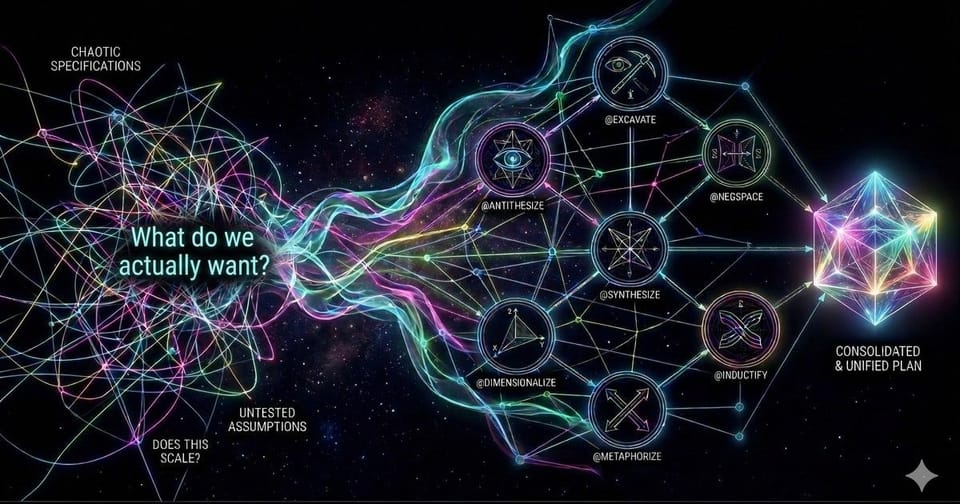
A few weeks ago I stumbled onto a GitHub repository by a finance quant named Jordan Rubin called Future Tokens. Rubin is interested in what he calls "LLM affordances": reusable commands that turn "the context you have into the context you need." Functionally, Future Tokens identifies repeating patterns of thought across different problems, names them, specs the desired outputs, and builds them into Claude Skills that aim to make common analytical moves "callable."
Rubin's skills are built around verbs like "Antithesize," "Dimensionalize," "Excavate," and "Rhyme." These are moves historians make all the time, though we call them by different names. Take Excavate, for example, which Rubin designed to surface hidden assumptions and buried premises inside an argument. Or Antithesize, which constructs the strongest possible case against a proposition. Or Dimensionalize, which exposes orthogonal axes for evaluating a set of options and then scores them. These sound suspiciously like things — critical reading, unpacking an argument, situating a work in its scholarly context — we have been teaching graduate students to do for generations.
Rubin's project isn't aimed at historians. He arrived at these operations from a completely different direction — trying to solve recurring problems in finance and product work. But he describes his skills with an analogy to cooking techniques — pre-heat, deglaze, salt-to-taste — that can be applied to recipes and cuisines from across the culinary spectrum. Ideally, for Rubin, Future Tokens would work similarly across knowledge domains.
I haven't done nearly enough with Future Tokens yet to offer any real assessment of whether that's true for history. I've only read the documentation and poked at a few of the operations. But if it is, it would suggest that the skills we won through hard study and long apprenticeship are more universal than we usually admit, closer to discrete, describable, transmittable techniques like reducing a sauce or tempering an egg.
That wouldn't mean there's no artistry in history. Just because you can deglaze a pan doesn't mean you can make a killer chicken piccata. But it would suggest a rethink of where in the "history stack" our true value as humans exists. These are the kinds of questions AI keeps raising, whether we're ready to answer them or not.
I'm planning to do more with Future Tokens and I'll report back when I have more to say. Specifically, I'm thinking about what some historian-specific additions might look like (Periodize? Contextualize?) In the meantime, you can read more about the project at Rubin's Substack. If you're a Claude Pro subscriber, the installation is straightforward. Just download the repository as a ZIP file, upload it as a skill, toggle it on.

Member discussion